
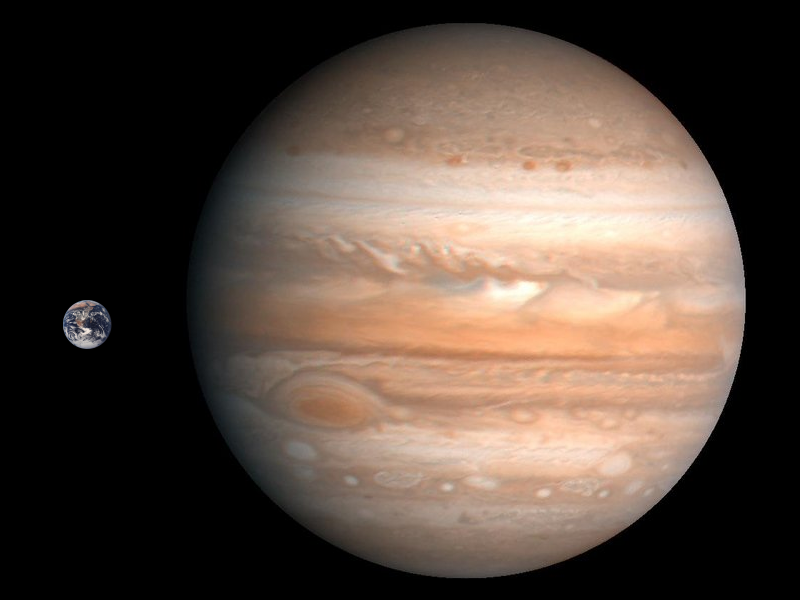
This list ranks the Top 5 most massive planets in the Solar System, using a single, objective metric: planetary mass measured in kilograms. The ranking covers only the eight officially recognized planets (Mercury through Neptune) and excludes dwarf planets and smaller bodies. Mass is an intrinsic physical property that determines a planet’s gravity, internal structure, and role in the dynamics of the Solar System, so comparing planets by mass is a straightforward way to understand their relative importance and influence.
Readers will find this topic interesting because mass drives many planetary characteristics — from atmospheric thickness and magnetic fields to the ability to retain moons and shape the orbital architecture of the system. The values and ordering below are taken from standard NASA/JPL physical parameters and verified secondary references; no additional sources or measurements were used.
Quick Comparison
| Rank | Item | Location | Ranking Value | Date/Year |
|---|---|---|---|---|
| 1 | Jupiter | Fifth planet from the Sun | 1.89813 × 1027 kg | Current standard physical parameter; undated |
| 2 | Saturn | Sixth planet from the Sun | 5.68317 × 1026 kg | Current standard physical parameter; undated |
| 3 | Neptune | Eighth planet from the Sun | 1.02409 × 1026 kg | Current standard physical parameter; undated |
| 4 | Uranus | Seventh planet from the Sun | 8.68103 × 1025 kg | Current standard physical parameter; undated |
| 5 | Earth | Third planet from the Sun | 5.97217 × 1024 kg | Current standard physical parameter; undated |
#5 — Earth

Location: Third planet from the Sun
Ranking value: 5.97217 × 1024 kg
Relevant year: Current standard physical parameter; undated
Earth ranks fifth in mass among the eight planets. As the terrestrial planet closest to the Sun that supports a complex biosphere, Earth’s mass determines surface gravity, atmospheric retention, and internal heat flow — all factors that make it uniquely habitable. Although Earth is much less massive than the giant planets, its mass is large enough to maintain a layered structure (core, mantle, crust) and an active geology. The verified interesting fact: Earth is the only planet known to support life, a distinction tied to its mass in combination with distance from the Sun and atmospheric composition.
#4 — Uranus

Location: Seventh planet from the Sun
Ranking value: 8.68103 × 1025 kg
Relevant year: Current standard physical parameter; undated
Uranus is the fourth most massive planet and one of the Solar System’s two ice giants. Its mass places it between Neptune and the terrestrial planets, reflecting a composition richer in volatile ices and gases than Earth but less massive than the gas giants. A striking verified fact about Uranus is its extreme axial tilt of about 98 degrees, which causes the planet to appear to roll on its side as it orbits the Sun. That unusual tilt is part of what makes Uranus distinct among the major planets and affects its seasonal cycles.
#3 — Neptune

Location: Eighth planet from the Sun
Ranking value: 1.02409 × 1026 kg
Relevant year: Current standard physical parameter; undated
Neptune is third by mass and the most distant of the Solar System’s planets. Its mass indicates a deep, fluid interior with a substantial envelope of hydrogen, helium, and heavier volatiles compared with the smaller planets. Neptune’s verified standout fact is its incredibly powerful winds — the fastest planetary winds known in the Solar System, exceeding 2,000 km/h. Those extreme winds are part of Neptune’s dynamic atmosphere, driven by internal heat and complex meteorology despite its great distance from the Sun.
#2 — Saturn

Location: Sixth planet from the Sun
Ranking value: 5.68317 × 1026 kg
Relevant year: Current standard physical parameter; undated
Saturn is the second-most massive planet. Its large mass produces strong gravity, a thick gaseous envelope, and an extensive system of moons and rings. One verified and widely noted fact about Saturn is that its average density is lower than that of water; taken as a whole, the planet would float if a suitably large body of water existed. That low average density stems from Saturn’s composition — mainly hydrogen and helium — and yet its mass is still substantial enough to dominate much of the outer Solar System’s gravitational landscape.
#1 — Jupiter

Location: Fifth planet from the Sun
Ranking value: 1.89813 × 1027 kg
Relevant year: Current standard physical parameter; undated
Jupiter tops the list as the most massive planet by a substantial margin. Its mass is more than twice the combined mass of all the other planets, making it the dominant gravitational presence in the Solar System. That enormous mass contributes to Jupiter’s strong gravity, extensive magnetosphere, thick atmosphere, and ability to retain a large system of moons. Jupiter’s size and mass also play a major role in shaping the orbits and impact history of other bodies in the system, including comets and asteroids.
How We Ranked Them
The ranking uses a single, exact metric: planetary mass expressed in kilograms. Values are taken from standard NASA/JPL physical parameters and verified secondary references listed below. Scope is strictly the eight officially recognized planets (Mercury through Neptune); dwarf planets and other solar system bodies were excluded by design. Reporting period: mass is an intrinsic physical quantity and the entries are labeled as current standard physical parameters (undated) per the verified data.
Uncertainties: the masses reported here reflect accepted scientific values; small revisions occasionally occur as measurement techniques improve, but no alternative values were used. Borderline candidates such as Venus are excluded because they are less massive than the lowest-ranked planet on this list (Earth). For reference, the verified next-excluded candidate is Venus with a mass of 4.86731 × 1024 kg; it therefore falls below #5. No dwarf planets or moons were considered for ranking because they fall outside the stated scope.
Frequently Asked Questions
Why is mass used instead of size or volume?
Mass is a fundamental physical property that determines gravitational influence, internal pressure, and many dynamic behaviors. Size or volume alone does not convey composition—two planets of similar size can have very different masses depending on density. This list ranks strictly by mass measured in kilograms, per the verified data.
Are dwarf planets like Pluto included?
No. The scope of this ranking is the eight officially recognized planets. Dwarf planets, moons, asteroids, and comets were excluded by the stated rules, even though some dwarf planets may be notable for other reasons.
Do these mass values change over time?
Mass measurements can be refined as observations and models improve, but planetary mass is an intrinsic property and changes only negligibly over human timescales. The values used here are the current standard physical parameters as cited in the verified sources.
Why is Venus not in the Top 5?
Venus is excluded because its mass (verified as 4.86731 × 1024 kg in the provided data) is lower than Earth’s mass, placing it below the fifth-ranked planet on this list. The ranking includes exactly five items—the five most massive planets among the eight recognized planets.
Sources
- NASA Science — Jupiter Facts — source for Jupiter’s mass and related physical parameters.
- NASA Science — Saturn Facts — source for Saturn’s mass and density fact.
- NASA Science — Neptune Facts — source for Neptune’s mass and wind-related fact.
- NASA Science — Uranus Facts — source for Uranus’s mass and axial tilt fact.
- NASA Science — Earth Facts — source for Earth’s mass and the statement that Earth supports life.
- OpenStax, Astronomy 2e — The Giant Planets — secondary reference supporting mass comparisons for the giant planets.
- OpenStax, Astronomy 2e — The Terrestrial Planets — secondary reference supporting terrestrial-planet context.
Last Updated
September 2026
Discover more from Magazine of AI
Subscribe to get the latest posts sent to your email.