
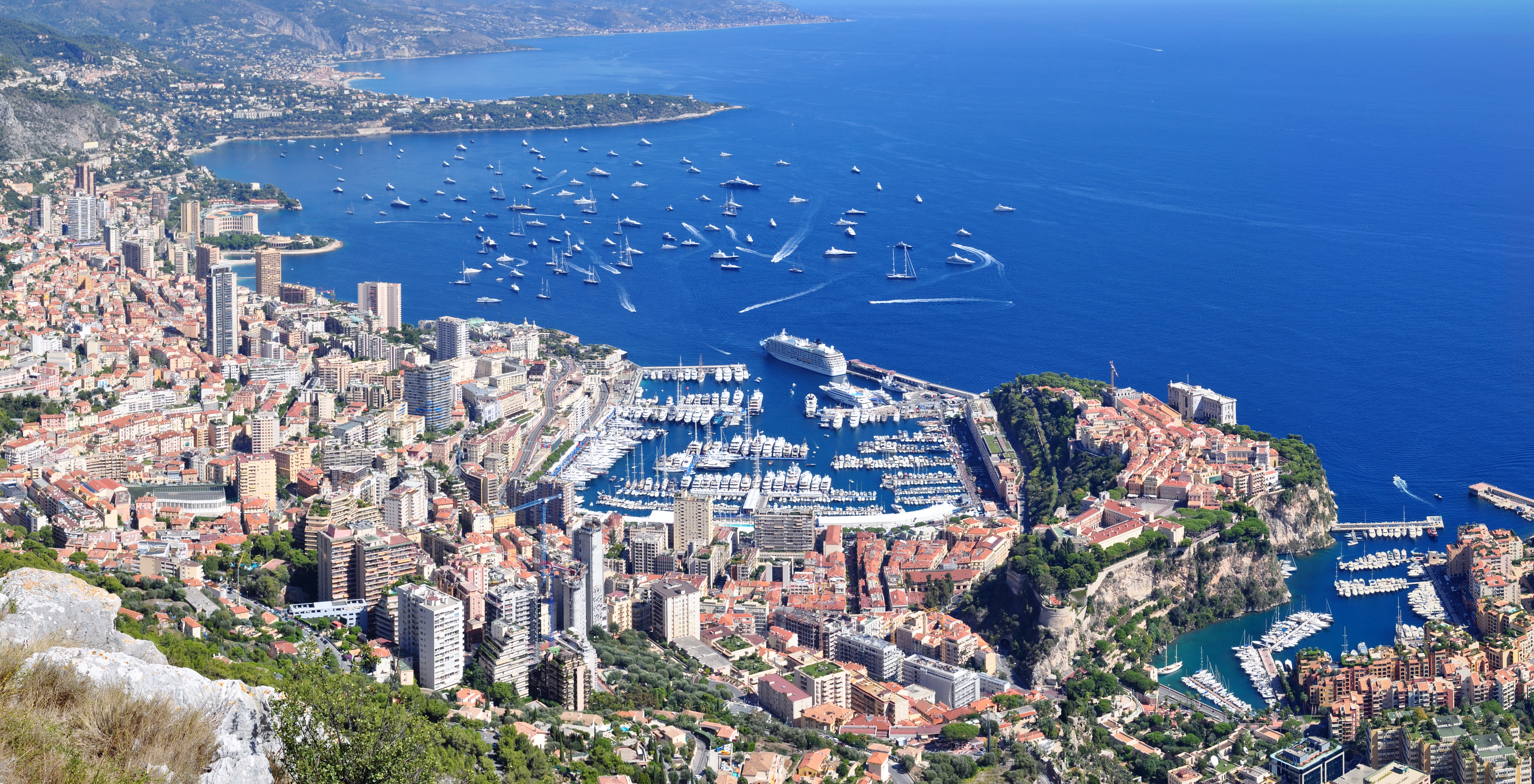
This list ranks the five sovereign countries with the highest population density in 2023, measured as people per square kilometre of land area. The ranking uses World Bank data (World Development Indicators, indicator EN.POP.DNST) and includes only sovereign states with comparable 2023 observations; dependent territories and special administrative regions are excluded.
Population density highlights how many people share a given amount of land and can illuminate urban concentration, land-use pressures and policy priorities in very small or highly urbanized countries. Using a single, consistent metric and reporting year allows a direct side-by-side comparison of how densely settled these countries were in 2023.
Quick Comparison
| Rank | Item | Location | Ranking Value (people/km²) | Date/Year |
|---|---|---|---|---|
| 1 | Monaco | French Riviera, Western Europe | 18,693 | 2023 |
| 2 | Singapore | Southeast Asia | 8,242 | 2023 |
| 3 | Bahrain | Persian Gulf | 1,971 | 2023 |
| 4 | Maldives | Indian Ocean, south of India and Sri Lanka | 1,765 | 2023 |
| 5 | Malta | Mediterranean Sea; Southern Europe | 1,727 | 2023 |
#5 — Malta
Location: Mediterranean Sea; Southern Europe
Ranking value: 1,727 people/km²
Relevant year: 2023
Malta ranks fifth on this list because its small land area combined with a compact population yields a high number of people per square kilometre. As the European Union’s smallest member state by area, Malta’s limited land supply concentrates residential, commercial and public uses into a compact territory. That geographic constraint is the primary reason its population density is higher than most sovereign countries but lower than the four that rank above it on this metric. The island nation’s EU membership and compact footprint are the useful context behind the verified fact that Malta is the bloc’s smallest member state by area.
#4 — Maldives

Location: Indian Ocean, south of India and Sri Lanka
Ranking value: 1,765 people/km²
Relevant year: 2023
The Maldives appears fourth in this ranking because its land area is extremely limited relative to its population, concentrating inhabitants on a large number of small islands. The country consists of roughly 1,200 coral islands grouped into 26 atolls, a geographic reality that constrains available land and contributes to a high density when calculated per square kilometre of land area. That island geography and distribution of settlements help explain why the Maldives exceeds Malta in people per km² under the 2023 World Bank measure.
#3 — Bahrain
Location: Persian Gulf
Ranking value: 1,971 people/km²
Relevant year: 2023
Bahrain ranks third by population density in 2023. As an island country in the Persian Gulf with limited land area relative to its population, Bahrain’s built environment and urbanized zones produce a high concentration of people per square kilometre. A notable geographic fact that helps explain Bahrain’s connectivity and development is its link to Saudi Arabia via the King Fahd Causeway, which facilitates cross-border movement and economic ties. These features combine to place Bahrain above the Maldives and Malta in the 2023 density ordering used here.
#2 — Singapore

Location: Southeast Asia
Ranking value: 8,242 people/km²
Relevant year: 2023
Singapore is second on this list with a population density of 8,242 people per square kilometre in 2023. As a sovereign city-state composed of one main island and numerous smaller islets, Singapore’s urban planning, compact land area and dense development lead to a very high population density measured on land area. Its status as a city-state explains both the intensity of settlement and why it ranks far above larger-but-less-densely-settled countries. The verified description notes Singapore’s composition of one main island plus smaller islands.
#1 — Monaco

Location: French Riviera, Western Europe
Ranking value: 18,693 people/km²
Relevant year: 2023
Monaco is the most densely populated sovereign country in 2023 by this metric, with 18,693 people per square kilometre of land area. Monaco’s extremely small land area combined with a substantial resident and working population results in the highest people-per-kilometre figure among sovereign states with comparable World Bank observations for 2023. The principality’s tiny size is also reflected in the verified fact that it is the world’s second-smallest sovereign state by area, after Vatican City—an important contextual detail when considering why Monaco’s density is so high.
How We Ranked Them
This ranking uses a single, consistent metric: population density measured in people per square kilometre of land area (World Bank indicator EN.POP.DNST). Values are taken from the World Bank World Development Indicators for the reporting year 2023. Only sovereign countries with a comparable 2023 World Bank observation were included; dependent territories and special administrative regions (for example, Macao, Hong Kong and Gibraltar) were excluded. Vatican City (Holy See) is not included because it lacks a comparable 2023 World Bank observation under this dataset-based method.
Where necessary, verification checked for possible borderline cases. For example, Bangladesh was evaluated as a potential contender but its 2023 World Bank density (approximately 1,333 people/km²) is below Malta’s and therefore it does not displace any of the five listed countries. The ranking order is strictly by the 2023 people-per-km² values reported in the World Bank dataset; no alternative metrics or years were used. This method avoids mixing measurements or including special territories that are outside the defined scope.
Frequently Asked Questions
Why are some densely populated places like Hong Kong or Macao not on the list?
Hong Kong and Macao are excluded because this ranking includes only sovereign countries with comparable 2023 World Bank observations. Special administrative regions and dependent territories are outside the scope of this sovereign-country list, so they are not considered even though their densities are high.
Does population density use total area or land area?
The metric used here is population density per square kilometre of land area, as reported by the World Bank (indicator EN.POP.DNST). That excludes inland water surfaces and focuses on land area where people live and economic activity occurs.
Why is Vatican City not listed even though it is very small?
Vatican City is not included because the World Bank dataset used for this ranking does not provide a comparable 2023 observation for the Holy See. The ranking only includes sovereign states with available 2023 World Bank data under the specified indicator.
What reporting year does this ranking use, and why?
This ranking uses the 2023 reporting year consistently for all included countries, based on the World Bank World Development Indicators (EN.POP.DNST). Using a single year ensures comparability across countries for the same point in time.
Sources
- World Bank — Population density, Monaco — 2023 population density (people per km²) for Monaco.
- UN Data — Monaco country profile — supplementary country profile for Monaco.
- World Bank — Population density, Singapore — 2023 population density (people per km²) for Singapore.
- UN Data — Singapore country profile — supplementary country profile for Singapore.
- World Bank — Population density, Bahrain — 2023 population density (people per km²) for Bahrain.
- UN Data — Bahrain country profile — supplementary country profile for Bahrain.
- World Bank — Population density, Maldives — 2023 population density (people per km²) for the Maldives.
- UN Data — Maldives country profile — supplementary country profile for the Maldives.
- World Bank — Population density, Malta — 2023 population density (people per km²) for Malta.
- UN Data — Malta country profile — supplementary country profile for Malta.
Last Updated
September 2026
Discover more from Magazine of AI
Subscribe to get the latest posts sent to your email.